The three seconds you’ve been missing.
It was 11:47 PM. In nine hours I had to walk back onto a national-television stage after publicly imploding on it twelve hours earlier. My spiral voice was telling me I’d peaked too soon, that this was going to define me, that everyone was about to watch me fail.
I did something that took three seconds. The next morning, I walked back on that stage and won.
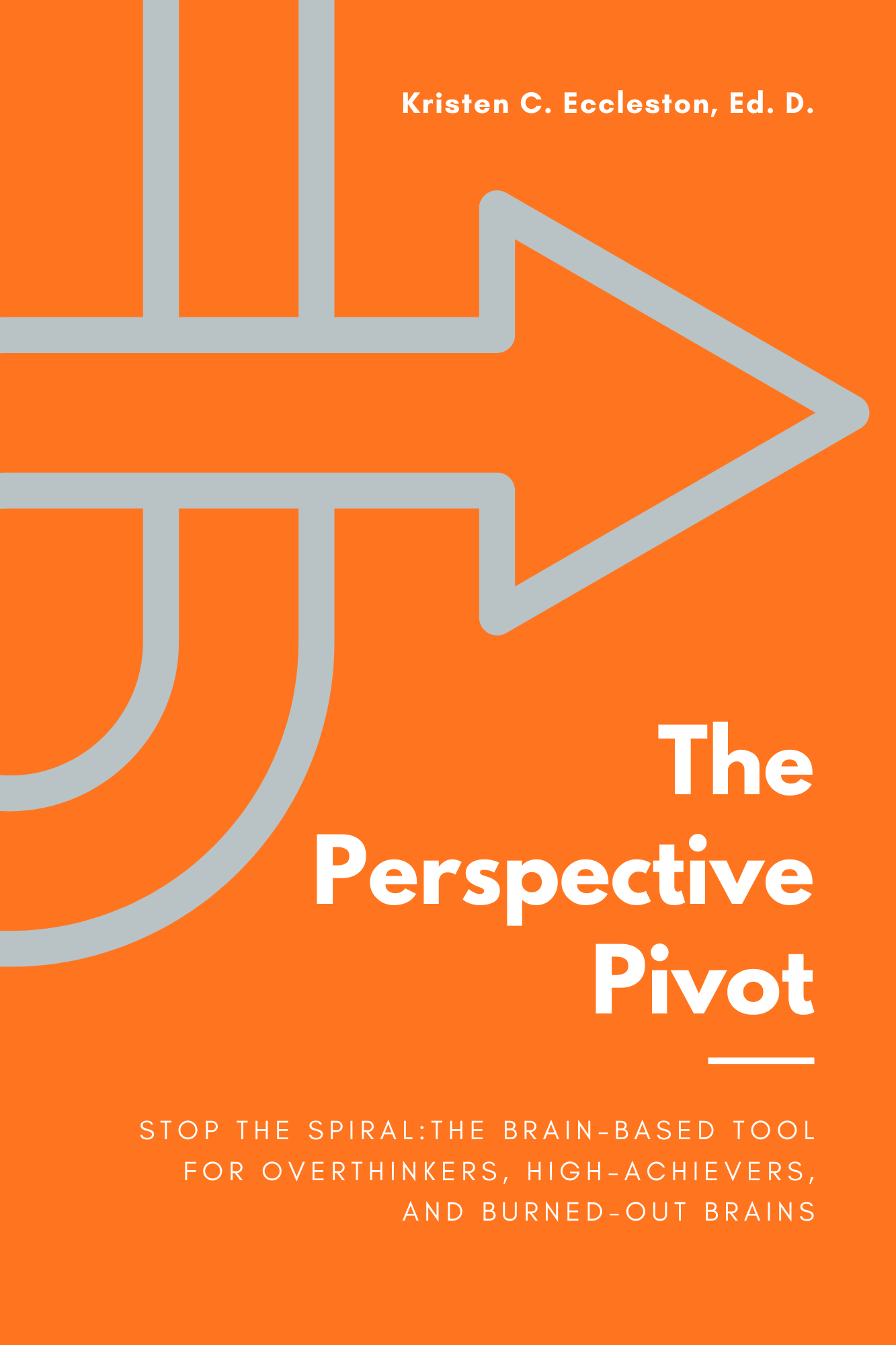
The Perspective Pivot is the three-step, brain-based tool I built from that moment. Not a mindset shift. Not a meditation. A nervous-system intervention you can run in the actual moment a spiral hits — in a meeting, in a meltdown, at 2am, on a bad brain day.
Praise
“Dr. Kristen gives you the tool most self-help books only promise.”
Wes Bergmann Founder of The Blox, MTV’s The Challenge
If you’ve ever felt invisible, this book sees you.
The world sees your performance. It does not see your pain.
You hold it together on the outside. You make the decisions, you run the meeting, you raise the kids, you take care of the patient, you mentor the team, you finish the doctorate, you keep the household running. And inside, your brain is running scenarios you cannot tell anyone about. The conversation from three weeks ago you’re still having with yourself. The email you read four times that you’re certain means you’re about to be fired. The Sunday night dread that started Friday afternoon. The way every neutral comment becomes evidence of something terrible.
If you have ADHD, autism, or any other form of neurodivergence — diagnosed, late-diagnosed, or quietly suspected — you’ve probably been told your whole life that simple things should not be this hard. They are not simple for your brain. They never were. You’ve been handed tools built for someone else’s wiring and asked why they don’t work on yours.
This book was built from the foundation up for the brain you actually have.
It is for the executive who makes million-dollar decisions and spirals for hours over a single email. The surgeon who performs flawless operations and lies awake replaying what an attending physician meant by “interesting approach.” The teacher who guides struggling students to breakthroughs and is convinced one observation will expose her as a fraud. The parent who researches every decision and is still certain she’s ruining her child. The high-achiever who’s just learning, in her thirties or forties or later, that there’s a name for why everything has always cost her so much more than it seemed to cost everyone else.
The people who look the most together are often the ones spiraling the hardest. You don’t have to perform strength anymore. You just need to understand your brain.
Not a philosophy. A nervous-system intervention.
Three steps. Three seconds. Sequenced in the order your brain can actually process when it’s already activated.
The Perspective Pivot: Acknowledge → Adjust → Align
Think of it as a traffic light for your brain. Acknowledge is the red light — stop, notice what’s happening. Adjust is the yellow — pause, consider alternatives. Align is the green — move forward with intention. The reason it works when other tools don’t is the order. You cannot think your way out of a spiral. You have to get your nervous system to participate first. The Pivot is sequenced for that.
The Triple-A Hand Hack
When threat floods your system, your thinking brain goes partially offline. Your motor patterns don’t. The Hand Hack is three physical gestures — one for each step — that anchor the Pivot in your body so the technique remains accessible even when your mind is somewhere else. It’s why this works in a meeting. In the car line. Mid-sentence in a hard conversation. At 2am when the spiral wakes you up. Your body gets to the reset faster than your thoughts can.
Spiral Immunity
Spirals feed on certainty, not facts. The Pivot doesn’t make anxiety go away — your nervous system is still wired for survival, and that’s not the goal. What changes is the activation window. Three days becomes thirty minutes. Drowning becomes treading water. Triggers stop carrying the predictive power they used to. You’re not working harder to manage spirals. You’re experiencing fewer spirals to manage.

About Kristen
I’m Kristen C. Eccleston, Ed.D. I have a doctorate from Johns Hopkins University in Mind, Brain, and Teaching, and I’ve spent twenty years doing one thing: getting to the root of what keeps complex brains stuck.
But I didn’t build the Perspective Pivot from the outside, watching other people struggle. I built it from inside my own collapse.
In December 2019, after years of overriding my own nervous system to take care of everyone else’s, my body stopped negotiating with my ambition. The version of me who could carry it all wasn’t coming back. What followed wasn’t a comeback story. It was grief, and then slowly, grace. I had to stop performing strength and start practicing honesty. I had to stop trying to get back to who I was and start asking who I was meant to become.
The Perspective Pivot is the tool I needed in that season and didn’t have. The framework I now teach to executives, surgeons, educators, parents, students, and people I will never meet who pick this book up at a moment they cannot describe to anyone — that framework was built by a brain in burnout, for brains in burnout. Not the calm brain. Not the regulated brain. The actual brain. On the actual day. Right when you need it.
Free companion resource
Not all spirals are the same.
Find out which one yours is — in five minutes.
Most people think they have one anxiety. What they actually have is one of four spiral patterns: Rumination, Catastrophic, Shutdown, or Productivity. They’re not diagnoses. They’re the specific shape your nervous system takes when it’s overwhelmed. Once you know which one is yours, the tools stop feeling generic and start feeling like they fit.
Take the free five-minute Spiral Type Self-Assessment. You’ll get the pattern your brain is running, the moments it tends to show up, and the Hand Hack variation built for your specific spiral. It comes to your inbox right after you finish.
No spam. No daily drip. I email when I have something useful to say.
Get the book.
Available in Kindle, Hardcover, and Paperback.
Available at Amazon, Apple Books, Barnes & Noble, Kobo, and other major retailers.
For schools, healthcare systems, and organizations.
When the spiral is happening at scale.
Burnout is no longer a personal problem. It’s an organizational one — and most institutional wellness programs are still built for brains that don’t spiral the way real high-performers do. The Perspective Pivot was built for the people your culture depends on most: the educators, the clinicians, the executives, the parents, the first responders, the leaders.
Bulk orders of The Perspective Pivot are available for districts, hospital systems, corporate teams, and conference attendees. Dr. Kristen also delivers keynotes, workshops, and embedded organizational consulting on neurodivergent cognition, brain-based performance, and the cost of high-functioning burnout.
If your people look fine and you know they’re not, this is the conversation we should be having.
Three seconds.
There are three seconds between a trigger and a spiral. A brief neurological window where choice still exists, before your brain locks onto a catastrophic story. Most people never know it’s there.
The Perspective Pivot teaches you to find it.
If something on this page made you think finally, somebody wrote this for the brain I actually have — order the book. If you’re not sure yet, take the free five-minute Spiral Type Self-Assessment. Either is a yes to yourself.
Released May 13, 2026 · Kindle · Hardcover · Paperback